

Our annual M&A Review examines the trends, opportunities and challenges shaping Australia's dealmaking landscape and provides insights into transaction activity across key sectors, including:
Drawing on our experience advising on a broad range of transactions, including cross-border acquisitions, private equity exits, capital raisings and strategic investments, the report explores the market, regulatory and industry developments influencing M&A activity across Australia.
Whether you are pursuing growth through acquisition, considering investment opportunities or navigating an increasingly complex regulatory environment, our review provides practical legal insights to help inform strategic decision-making and transaction planning.
Stay ahead in Australia’s dealmaking landscape. Our annual M&A Review examines the trends, opportunities and challenges shaping transaction activity across key sectors, including renewable energy, technology, investment funds, real estate and healthcare.
Download NowAustralia remains an attractive investment destination, supported by its strong regulatory framework, skilled workforce and exposure to long-term structural growth sectors.
Privacy risk is no longer a back-office compliance issue in Australian M&A. Recent regulatory activity, including the Privacy Commissioner’s determination concerning Bunnings’ use of facial recognition technology, scrutiny of third-party tracking technologies and a more assertive enforcement approach from the Office of the Australian Information Commissioner (OAIC), means privacy risk is increasingly becoming a diligence, valuation and liability issue, rather than a box-ticking exercise.
In 2024, the Privacy Commissioner determined that Bunnings Warehouse had interfered with individuals’ privacy by deploying facial recognition technology in stores and collecting customers’ biometric information, being sensitive information under the Privacy Act 1988 (Cth), without satisfying the relevant collection requirements.
While Bunnings successfully appealed one aspect of the determination in the Administrative Review Tribunal, the remaining findings were upheld. The decision highlights the regulatory risks associated with large-scale, passive data collection through ambient technology, even where a business is pursuing legitimate objectives such as security or loss prevention.
Targets with physical premises, high customer footfall or workforce monitoring tools should be assessed for technology deployments that may be undocumented, poorly understood or disclosed.
A target using biometric tools for loss prevention, workforce management or customer analytics may carry regulatory exposure that is not apparent from its privacy policy or data register.
Tracking pixels present another diligence risk. Third-party pixel technology and tag-management tools can transmit personal information to advertising and analytics platforms, sometimes without the business knowing the underlying data flows. As a result, privacy notices may not accurately reflect what a target’s digital infrastructure actually collects, shares or enables.
Standard data room disclosures may also omit pixel configurations, analytics integrations, software development kits, customer data platforms or third-party tags, making technical reviews increasingly important for consumer-facing websites, apps and digital marketing channels.
Privacy weaknesses are becoming more visible, more enforceable and more material to deal value.
Buyers must treat data privacy as a value and liability issue on par with intellectual property, cybersecurity and employment obligations.
Due diligence should assess not only what a target says in its policies, but what it actually does with personal information across systems, premises, vendors and customer-facing channels, including the use of biometric technologies, tracking tools, data-sharing arrangements and any history of regulatory scrutiny or data breaches.
Transaction documents must also address identified risks through targeted representations, warranties, covenants and indemnities, where appropriate.
Privacy diligence must be technical, contractual and governance-focused. A target’s relationship with personal information may affect valuation, risk allocation and post-completion remediation just as materially as any other core asset or liability.
Author: Lyn Nicholson, General Counsel - Corporate & Commercial
Australia’s mandatory merger control regime commenced on 1 January 2026, and the ACCC’s first six months of data provides valuable insight into how the new framework is operating.
Early indications suggest the regime is functioning efficiently, with most notification and waiver determinations completed within expected timeframes and only a small number of matters progressing to Phase 2 review.
ACCC data for the period 1 July 2026 to 30 June 2026 indicates that the highest levels of transaction activity have been recorded in Financial and Insurance Services, Manufacturing, and Professional, Scientific and Technical Services. These findings suggest that sectors characterised by consolidation, strategic acquisitions, vertical integration and complex service-based or data-driven business models are among the earliest and most frequent users of the new regime.
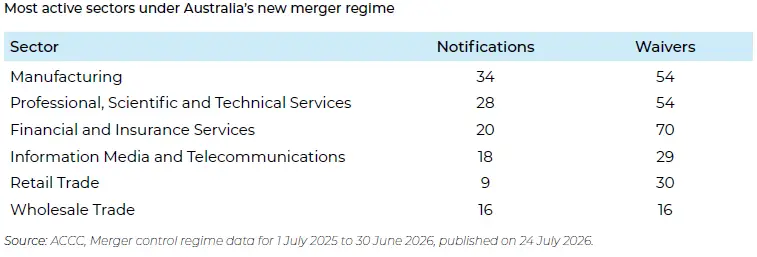
The data suggests the new regime is not creating barriers for the vast majority of transactions, with most acquisitions progressing through the system efficiently. However, it is changing how transactions need to be planned, with competition analysis increasingly becoming a front-end transaction issue requiring businesses to assess regulatory risks much earlier in the deal process.
The ACCC’s recent opposition to Coles’ proposed acquisition of a leasehold interest for a supermarket development in Kalgoorlie, Western Australia, reinforces this shift. While the decision was heavily influenced by the particular characteristics of the Kalgoorlie market and the ACCC’s concerns regarding the viability of an existing independent competitor, it demonstrates the regulator’s willingness to closely scrutinise acquisitions involving strategic assets, leasehold interests and development opportunities.
Notably, this was the first ACCC opposition to an acquisition under the new regime. Coles has appealed the decision in the Australian Competition Tribunal.
The ACCC’s approach in the Ampol/EG Australia transaction provides a useful contrast. While the ACCC identified competition concerns in a number of local fuel markets, it approved the acquisition subject to Ampol divesting 41 retail fuel sites to an ACCC-approved purchaser. The decision demonstrates that transactions raising competition concerns are not necessarily prevented from proceeding, provided an effective remedy can be implemented to address the ACCC’s concerns.
These decisions are a timely reminder that businesses should not view merger compliance solely through notification obligations. The new merger regime introduces a mandatory and suspensory approval process for certain transactions, but it does not replace section 50 of the Competition and Consumer Act 2010 (Cth). That is, the ACCC retains the ability to examine transactions that may substantially lessen competition, including transactions that fall below notification thresholds.
Consequently, competition law risk may arise even where notification thresholds are not met or the parties consider the transaction to be commercially benign. The focus remains on whether the transaction may substantially lessen competition. This assessment can extend beyond traditional business acquisitions to transactions involving strategic assets, leasehold interests and development rights.
For buyers and investors, the message is clear: competition law analysis should form part of transaction planning from day one. Early assessment of competition and regulatory risks can help avoid delays, preserve deal certainty and determine whether ACCC engagement is required.
Businesses that leave these issues until late in a transaction risk significant delay, investigation or prohibition of the entire transaction, exposing the parties to substantial regulatory and commercial risk.
The early data suggests the new regime is not preventing deals from proceeding, but it is changing how they are assessed. As the ACCC builds a deeper record of transactions and market activity, businesses pursuing growth through acquisitions, particularly repeat or serial acquisitions, should expect greater scrutiny of cumulative effects on competition.
Early competition law assessment will remain critical to preserving deal certainty and mitigating execution risks.
Author: Suzanne Howari, Special Counsel - Corporate & Commercial
Foreign investment continues to attract heightened regulatory attention, particularly in sectors such as renewable energy and critical infrastructure.
One of the most significant policy signals from the 2026–27 Federal Budget is the government’s indication that it is considering targeted capital gains tax (CGT) settings for foreign investors in eligible renewable energy infrastructure assets.
While the scope and mechanics of any concession remain subject to legislative development, the direction of travel is clear: the government recognises CGT settings as an important lever for attracting institutional capital, sovereign wealth funds and infrastructure sponsors to Australian renewable projects in an increasingly competitive global market for clean energy investment. For a broader discussion on the CGT reforms, see page 15.
The Foreign Investment Review Board (FIRB) process has also become more streamlined. The Foreign Investment Portal, introduced in May 2025 and progressively enhanced through to March 2026, has improved application lodgement, centralised correspondence and compliance reporting by replacing fragmented email-based communication with a single auditable system.
Treasury has also set a target of processing 50% of applications within the 30-day statutory period, and aggregate processing times have improved.
While reforms have improved aspects of the FIRB process, foreign investment approvals remain a key transaction consideration.
Importantly, the published improvements in processing times are not evenly distributed across application types. National security business applications, which include most acquisitions of operating renewable energy assets of a certain size, continue to take considerably longer in practice.
In addition, FIRB timelines remain influenced by a multi-agency review process, meaning approval timelines are not within FIRB’s sole control.
As a result, foreign investment considerations are increasingly influencing transaction structuring, due diligence and execution. Regulatory timing can also directly affect deal certainty, pricing and completion timetables, particularly for complex inbound investments.
In our experience, the most effective way to manage application risk is to engage early.
Businesses should address foreign investment considerations at the outset of a transaction, provide clear and complete disclosure of ownership structures, funding sources and strategic intentions, and engage advisers before formal lodgement rather than treating FIRB as a late-stage regulatory step in the deal process.
Foreign investment will continue to play an important role in Australian dealmaking, particularly in sectors benefiting from long-term structural growth.
Businesses considering inbound investment should engage advisers and, where appropriate, the regulator early to ensure approval requirements and timing do not become barriers to an otherwise well-structured transaction.
Author: Jeanne Vallade, Partner - Corporate & Commercial
Australia’s tax environment is undergoing its most significant shift in years. The expansion of the capital gains tax (CGT) net for foreign investors and the 2026–27 Federal Budget’s overhaul of the domestic CGT rules that drive holding structure decisions are already influencing transaction terms.
Legislation before Parliament broadens the meaning of taxable Australian real property, which is a relevant concept in determining a foreign resident’s Australian CGT liability. The latest Bill does not carry through the retrospective application to CGT events from 12 December 2006 proposed in the April 2026 exposure draft. The expanded definition will apply only to CGT events happening on or after commencement, being the first 1 January, 1 April, 1 July or 1 October after Royal Assent, and the Bill separately limits the Commissioner’s power to amend earlier assessments.
Key reforms include replacing the point-in-time principal asset test with a 365-day testing period and introducing new notification requirements for certain foreign resident vendors. Those wishing to declare that a membership interest is not an indirect Australian real property interest must notify the Australian Taxation Office before a disposal valued at AU$50 million or more, and purchasers cannot rely on that declaration unless notification has been made.
The Bill also introduces a time-limited 50% CGT discount for foreign residents other than individuals disposing of eligible Australian renewable energy assets, available for CGT events up to 30 June 2030.
Combined with the 15% foreign resident capital gains withholding regime, the reforms are expected to result in longer transaction timetables, deeper due diligence on asset composition, and more challenging negotiation of warranties, indemnities and escrow arrangements.
The first tranche of these measures is now law, having received Royal Assent on 26 June 2026. From 1 July 2027, the 50% CGT discount for individuals and trusts will be replaced by cost base indexation and a 30% minimum tax on capital gains made by Australian resident individuals, directly or through trusts, although the discount will continue for eligible new residential dwellings and affordable housing.
Pre-CGT assets will enter the CGT net and negative gearing deductions for residential property will be limited to new residential dwellings and properties acquired before 7:30pm on 12 May 2026, with excess losses quarantined against residential property income and gains. Companies, superannuation funds and foreign residents will retain their existing treatment.
The minimum tax on discretionary trusts remains a proposal, with Treasury releasing a consultation paper on its design on 8 July 2026. From 1 July 2028, trustees of discretionary trusts will be subject to a minimum 30% tax on trust taxable income. Existing trusts will not be grandfathered, although fixed trusts, widely held trusts, complying superannuation funds, deceased estates, charitable trusts, primary production income and most testamentary trusts are to be excluded.
Corporate beneficiaries will not receive a credit for that tax, meaning traditional bucket company arrangements may be exposed to economic double taxation at an effective rate of around 60%, or around 70% where the company then pays a franked dividend to a shareholder on the top marginal rate.
Separately, corporate tax entities that are not significant global entities will be able to carry back a tax loss for an income year starting on or after 1 July 2026 and apply it against tax paid in either or both of the two previous income years, generating a refundable tax offset capped at the entity’s franking account balance.
Depending on investment strategy, companies may become more attractive in vehicle selection if indexing a cost base is worth less than sheltering income at 30% and reinvesting returns repeatedly.
Investments qualifying for venture capital limited partnership and early-stage venture capital limited partnership treatment will retain their concessions and may therefore become relatively more attractive. Treasury has also released a consultation paper on a new 50% CGT discount for early-stage investors, including founders and employee share scheme participants in innovative start-up businesses.
The aggregated turnover threshold for the small business 50% reduction rises from $2 million to $10 million from 1 July 2027, which will matter at the smaller end of the market.
Bespoke share class structures may also present an opportunity for some planning if carefully designed.
Groups holding assets in discretionary trusts with bucket companies should review their structures now. The High Court’s June 2026 decision in Bendel confirmed that a corporate beneficiary’s unpaid present entitlement is not a deemed dividend for Division 7A purposes, although the government has confirmed it will legislate the Commissioner’s former position.
A three-year restructure rollover opens on 1 July 2027, extending beyond small business entities to passive assets. The destination vehicle must produce fixed and transparent economic outcomes, meaning a discretionary trust cannot simply be replicated in another form.
The consultation paper indicates that the relief will be modelled on the small business rollover provisions without a genuine restructure requirement, and that it will not be available where assets are transferred to a company with multiple classes of shares allowing dividends or capital returns to be allocated on a discretionary basis.
The rollover gives no relief from transfer duty, which is an important cost to consider for groups holding property and, depending on the jurisdiction, business assets. The trust deed must also empower the trustee to transfer assets on the terms the concession requires.
Tax is becoming an increasingly important transaction planning issue. Businesses should review existing arrangements early and assess whether their current structures remain fit for purpose.
Author: Dhanushka Jayawardena, Partner - Taxation
• Battery energy storage systems (BESS) have become the most sought-after renewable energy asset class, with investors favouring construction-ready storage projects.
• Execution certainty is driven by value, with grid connections, planning approvals and contracted offtake attracting premium pricing.
• The transition to the GO scheme is creating new due diligence and transaction structuring considerations, particularly for operating assets and legacy Power Purchase Agreements.
Australia’s renewable energy sector remains one of the most active M&A markets globally, and that momentum has continued into 2026. The scale, diversity, and geographic breadth of transactions we see across solar, wind, battery storage and development platforms continue to reinforce Australia’s position as a core destination for clean energy investment.
Investor appetite for storage assets has grown significantly, and BESS now sits at the centre of many acquisition strategies. Infrastructure capital has moved decisively towards execution-ready storage assets, with a clear preference for late-stage or construction-phase projects that carry contracted offtake and reduced delivery risk.
Across the market, buyers are favouring de-risked assets with stable cash-flow visibility over speculative development pipelines, and sellers that have successfully completed key development and construction milestones are finding a ready pool of institutional acquirers.
From our perspective, a two-sided dynamic is emerging around BESS. On the sell side, developers are bringing developed or near-development assets to market, often once they have been sufficiently de-risked to attract institutional buyers. On the asset management side, those same developers and operating asset owners are adding BESS to their existing projects to improve commercial performance by mitigating curtailment risk while enhancing their attractiveness to future acquirers.
As a result, BESS is increasingly seen as a value-add that strengthens the case for a renewable project rather than a standalone investment.
The strategic rationale is reinforced by a growing grid constraint problem. The Australian Energy Market Operator (AEMO) has warned that major solar farms in south-east Australia may be forced to curtail more than a third of their output by 2027 due to transmission delays. BESS provides a commercial hedge against this risk by storing excess generation and dispatching it during periods of peak demand or network constraint.
For investors, co-locating or acquiring adjacent storage capacity is increasingly embedded in the acquisition thesis for operating renewable assets.
Grid connection timing, EPC pricing, planning approvals and the growing complexity of competing land use rights, including conflicts with mining and pastoral tenures, are also adding material execution risk to portfolios that appear attractive on paper. In this environment, sellers with credible projects, secured grid connections and contracted offtake continue to command premium pricing.
Australia’s renewable energy certification system is also undergoing fundamental change. The transition from the Large-scale Generation Certificates (LGC) regime to the Guarantee of Origin (GO) scheme is adding a further layer of complexity to renewable energy transactions. Both regimes will operate in parallel until 31 December 2030, although only one certificate—either an LGC or a Renewable Electricity Guarantee of Origin (REGO) certificate—can be created for each unit of energy.
For investors acquiring operating renewable assets or portfolios with legacy Power Purchase Agreements drafted around LGC mechanics, this is a material due diligence and contract renegotiation issue. The certificate revenue assumptions embedded in acquisition models will need to be carefully stress-tested against the REGO framework, which operates under different commercial and market dynamics.
Misalignment between contractual obligations and scheme requirements can expose buyers to revenue risk and, in some cases, greenwashing scrutiny.
We expect deal flow in this sector to remain strong in 2027, driven by Australia’s target of 82% renewable electricity by 2030, the Capacity Investment Scheme and AEMO’s estimated AU$142 billion investment pipeline.
BESS will continue to attract the strongest institutional interest, while development assets with secured grid connections and a clear path to financial close are expected to remain in demand.
However, investors will continue to be selective. Curtailment risk, wholesale pricing dynamics and contractual uncertainty surrounding the LGC-to-REGO transition will influence risk allocation and pricing in transactions, as will evolving FIRB conditions on foreign-owned energy infrastructure.
Author: Jeanne Vallade, Partner - Corporate & Commercial
Artificial intelligence (AI) continued to be a key driver of M&A activity in 2026. Across the region, we are seeing increased investment activity and transactions where digital transformation and AI capability are becoming prerequisites for investment decisions. We expect this trend to continue as investors increasingly seek businesses with proprietary technologies in AI and skill sets that can drive the technology.
Southeast Asia, particularly in Singapore and Indonesia, appears to remain attractive for private equity and venture capital activity. The VC ecosystems and emerging technologies continue to grow, as do the deals supporting investment in the sector. With increasing adoption and development of AI across businesses, investors are finding an abundance of acquisition targets in high-growth markets across the region that can be selected and scaled for growth.
Technology-driven growth in markets such as Singapore and Australia also remains a key theme in cross-border transactions. The ease of doing business, strong growth prospects and productivity gains from AI transformation continue to make these investor-friendly countries attractive targets.
While Southeast Asia is a focal point for growth in the technology and AI sectors, the Australian M&A market appears to be focused on acquiring niche AI businesses rather than developing growth stories.
Australia’s robust and stable regulatory regime and mature technology sector are significant drawcards for investors, particularly when combined with a growing VC ecosystem across the country’s major cities. Even smaller markets such as Canberra are experiencing significant investments and cross-border deal activity in this space.
The rapid growth of AI is also driving increased investment in support infrastructure. Demand for hyperscale data centres continues to increase as businesses invest in the computing power and storage capacity required to support the use of AI.
Melbourne appears to be the fastest-growing centre for data centre investment due to the abundance of land opportunities compared to Sydney. How the regulatory landscape evolves alongside the adoption of AI infrastructure and related M&A activity will be an interesting trend to watch.
M&A activity involving AI is expected to remain strong across the region over the next 12 months. As investors become increasingly selective on deals involving AI-focused companies, businesses with strong financials and a defendable pipeline of potential business will continue to attract interest, particularly as AI adoption expands across industries.
The Australian Prime Minister’s recent announcement of an AI Office only heightens the prominence of AI in the M&A landscape in Australia and Southeast Asia.
Author: Ben Constance, Partner- Corporate & Commercial
The past 18 months saw an enormous level of activity in the Australian financial services industry. In February 2025, the Australian Securities and Investments Commission (ASIC) released a discussion paper on Australia’s evolving capital markets, highlighting three major themes: declining public listings, rapid growth of private capital and private credit, and the increasing influence of superannuation capital on Australian markets.
ASIC expressed concern that regulatory settings had not kept pace with the structural shift from public to private markets and identified significant gaps in transparency, valuation standards, governance and regulatory data collection.
The discussion paper ultimately led to ASIC’s November 2025 response report, which outlined an extensive regulatory roadmap for private markets, wholesale funds, superannuation and public market reform.
The most significant regulatory development has been ASIC’s increased focus on private wholesale funds. ASIC conducted surveillance of private credit funds, issued stop orders against several retail private credit products and identified deficiencies in governance, conflicts management, valuations, liquidity management and disclosure practices.
ASIC also released a detailed framework of ‘better practices’ for private credit managers and signalled stronger enforcement activity.
In December 2025, ASIC updated Regulatory Guide 181 (Conflicts of Interest) to substantially widen the obligation on Australian Financial Services Licensees (AFSLs) to manage conflicts.
ASIC launched a two-year fast-track IPO trial, approved Cboe’s corporate listing market, and commenced an inquiry into ASX governance and risk-management frameworks.
In July 2026, ASX released for consultation a simplified fifth edition of the ASX Corporate Governance Principles and Recommendations. The proposed reforms focus on clearer, principles-based governance standards rather than additional prescriptive requirements.
ASIC also indicated its intention to review prospectus disclosure (Regulatory Guides 228 and 254), sell-side research rules (Regulatory Guide 264), and listing frameworks as part of a broader effort to improve the competitiveness of Australian capital markets and encourage market operators to develop lighter-touch listing rules for small and medium-sized enterprises.
For fund managers, the overarching theme is clear: Australia is moving toward a more heavily supervised private markets regime, with stronger governance, disclosure, valuation and reporting obligations, while simultaneously seeking to reduce friction for capital formation and international investment.
Author: Andrew Stone, Partner - Corporate & Commercial
Australia’s real estate market continues to attract significant investment interest, although dealmaking is becoming increasingly selective.
While capital remains available, investors are focusing on assets with resilient income streams, clear strategic value and long-term growth opportunities. This is supporting continued activity across high-quality retail, industrial, logistics and digital infrastructure assets, while more complex or capital-intensive transactions face greater scrutiny from buyers and investors.
Growing volumes of capital are being directed towards data centres and associated digital infrastructure, with investors increasingly viewing these assets as long-term infrastructure plays rather than traditional property investments.
As a result, access to power, grid capacity and development-ready land is becoming a critical driver of transaction value. The proposed $10 billion data centre hub near Morwell, Victoria, reflects both the scale of capital being deployed into the sector and the growing strategic importance of regional locations capable of supporting large-scale AI and digital infrastructure projects.
Buyers are undertaking deeper due diligence and placing greater emphasis on income sustainability, lease quality, regulatory approvals, planning constraints and asset readiness. We have seen this reflected through parking management companies not willing to commit to longstanding leasing transactions for building car parks in response to the fuel crisis.
This selectivity is particularly evident in the retail sector. Regional and neighbourhood retail centres continue to attract strong investor interest due to their diversified income streams and strong underlying tenant mix, while larger sub-regional centres are attracting investors seeking assets with redevelopment or active management potential.
The ACCC’s opposition to Coles’ proposed acquisition of a leasehold interest for a supermarket development in Kalgoorlie, Western Australia, demonstrates that merger scrutiny can extend beyond traditional business acquisitions to property, leasehold and development rights transactions.
For landlords leasing to supermarkets and developers seeking supermarket tenants, competition law analysis should now form part of transaction planning from day one.
Investor interest is expected to remain strongest in asset classes with resilient income streams and clear long-term growth prospects. While capital remains available, investors are likely to continue prioritise execution certainty, making early preparation, comprehensive due diligence and proactive risk management increasingly important.
Author: Samantha Gou, Partner - Property, Planning & Development
Australia’s healthcare sector remains one of the most resilient and consistently active segments of the domestic M&A market. While investors have become increasingly selective, healthcare continues to attract significant strategic and financial capital, supported by strong demographic fundamentals, defensive earnings characteristics and growing demand for healthcare services.
One of the defining themes of the past 12 months has been the increasing importance of technology as a value driver. Rather than replacing traditional healthcare services investment, technology is increasingly acting as a differentiator, with investors favouring businesses that combine strong clinical or service delivery capabilities with scalable technology, data and automation platforms.
Primary care, allied health, specialist medical services and aged care continue to present attractive acquisition opportunities in a highly fragmented market.
Recent transactions, including Q & M Dental’s proposed AU$119.64 million acquisition of Experteeth Dental Group, demonstrate how investors are pursuing scale through established clinic networks and healthcare services platforms with growth potential.
Australia’s ageing population, increasing healthcare expenditure and growing prevalence of chronic disease continue to underpin long-term, non-cyclical demand across the sector. Government-supported funding arrangements, including Medicare and aged care funding, provide earnings resilience that remains attractive to both financial and strategic buyers.
We expect healthcare M&A activity to remain resilient through 2027, although buyers are likely to remain disciplined and highly selective. Strategic consolidation across MedTech, diagnostics, allied health and broader healthcare services is expected to continue, with the strongest demand for businesses that combine resilient earnings with technology-enabled growth opportunities.
AI adoption across clinical diagnosis, treatment planning and operational functions is also expected to accelerate, ensuring that privacy, cybersecurity, governance and regulatory compliance remain key due diligence considerations.
Healthcare businesses with defensible market positions, visible earnings and credible technology roadmaps are likely to remain among the most sought-after acquisition targets in the Australian market.
Author: Hannah Haidley, Senior Associate - Corporate & Commercial