

18 June 2026
34 min read
Published by:

Following our initial discussion of the Building (Approvals and Practitioners) Bill 2026 (Bill), this series takes a deeper dive into its provisions and their impact on the construction industry.
By way of recap, the Bill is a key piece of proposed legislation aimed at overhauling the building approvals regime in New South Wales. It introduces significant reforms, including changes to the approvals system and the role of certifiers, as well as a new statutory framework for prefabricated buildings. It is intended to streamline approval processes and support the NSW Government in meeting its housing targets.
This first article covers parts one to three of the Bill, which includes preliminary provisions, key definitions and the new approvals framework.
The aim of the Bill is to:
Modular construction has been a key area of regulatory interest and this is reinforced at the outset of the Bill by certain provisions relating to modular construction coming into effect first, on the date of assent, ahead of the balance of the Bill. Specifically, those provisions are amendments to the Environmental Planning and Assessment Act 1979 (EPAA):
Part one otherwise reinforces NSW’s commitment to mutual recognition and provides that the Bill is applicable to interstate licensees operating under mutual recognition.
Part two of the Bill introduces key concepts that underpin the new regime. Central to this is the distinction between ‘building work’ (physical activity involved in the erection of a building) and ‘approvals work’, with the latter covering:
The definition of ‘building work’ leaves a lot of room for clarification by Regulation. It remains to be seen whether the term will include coordination and supervision, as it does in the Home Building Act 1989 (NSW) (HBA).
Other key terms in the Bill largely align with existing regimes. For example, ‘registered work’ refers to work that may only be carried out under a registration, while ‘building element’ adopts the definition in the Design and Building Practitioners Act 2020 (NSW) (DBPA), with minor amendments to improve clarity.
The definition of ‘close associate’ essentially repeats that in the HBA, but the net is cast wider in that the employee or agent criteria looks back 12 months, parent company is added and the concept of significant influence is introduced, where a person who can directly or indirectly influence another person or their business or operations because of a relevant financial interest or power.
The Bill also introduces a new definition of ‘prefabricated building’ which, if manufactured away from the building site, is
The Regulation may add or exclude things from being prefabricated buildings and may modify how the Bill (if passed) and the HBA apply to prefabricated buildings, work involving prefabricated buildings and persons carrying out that work. The Secretary may also publish guidelines to assist in determining what falls within the definition and which courts or tribunals can decide whether a structure is a prefabricated building. Together, these mechanisms reinforce the flexibility contemplated in the objects.
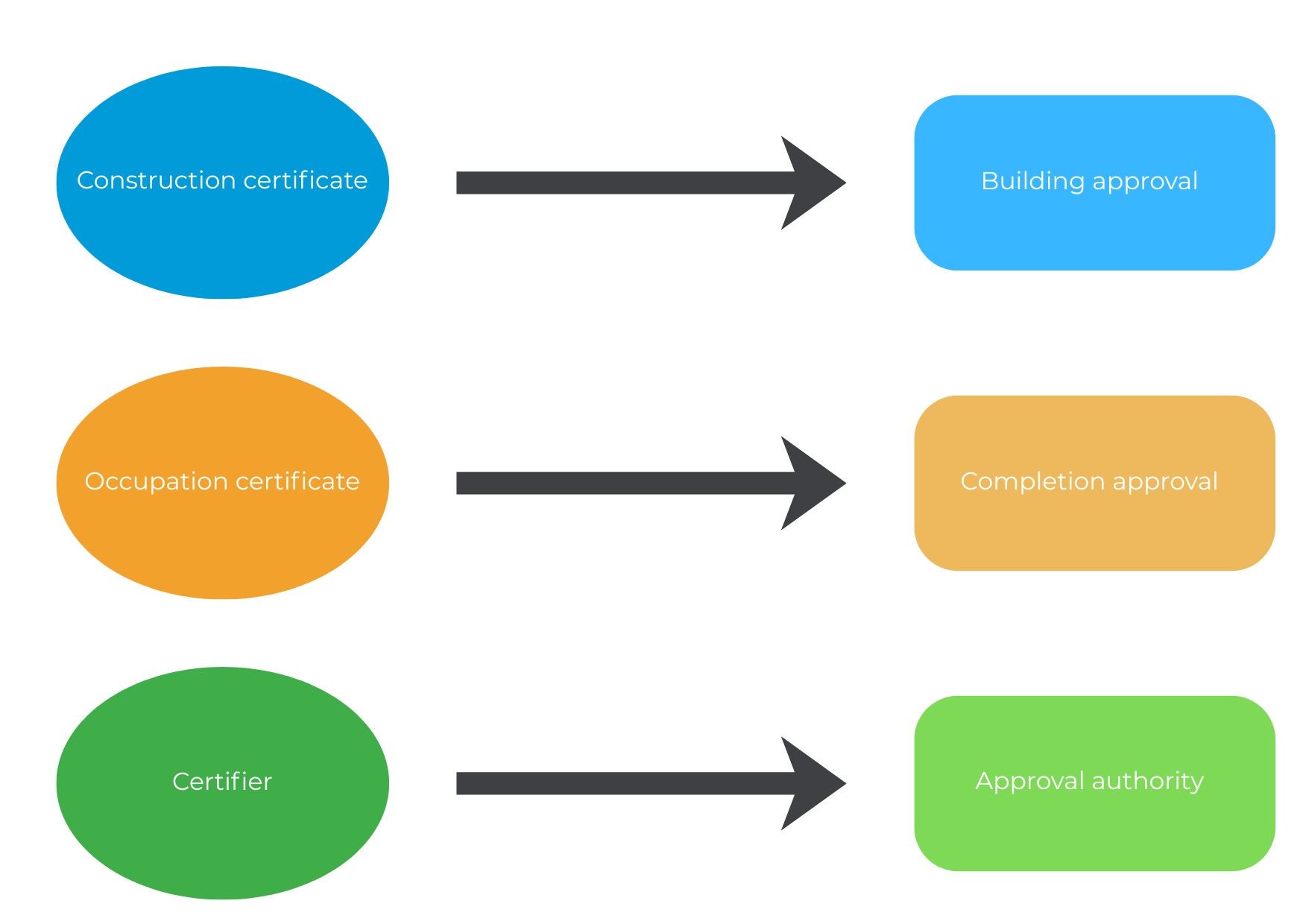
Part 3 of the Bill provides a framework for the approval and oversight of building works. The new approval-based system will replace the existing certificate-based system set out in the EPAA, with the new building approvals replacing traditional construction certificates, and completion certificates replacing occupation certificates. This part also adopts a number of divisions from the DBPA, maintaining the requirements on design and building practitioners.
Building approval
The starting point is that building work requires building approval (unless it is carried out as a complying development). Development consent is not building approval. Building work must not be carried out unless it is authorised by a building approval (or a CDC) , or other than within the building approval (or a CDC).
Approval may be sought by the landowner or another person with the landowner’s consent, but not by the builder (unless the builder is the owner). The application must indicate or nominate the approval authority.
An application for approval for building work on a building element must be accompanied by a regulated design and a design compliance declaration. This creates a paper trail that is more centralised than the current process, as the declaration must be made at a time prior to the commencement of building work. This is likely to make the regulated designs more accessible to subsequent owners, particularly where the approval is issued by a council.
An application for approval for building work involving a performance solution must be accompanied by a report as to adequacy of the performance solution. Where the solution is a higher risk performance solution, the report is to be prepared by an appropriate registration holder and contain a performance solution report compliance declaration.
Where building work is staged, separate applications are required and approvals only apply to the relevant stage. The approval authority must consider the impact on other stages. The approval application for the first of those stages must include a staging schedule.
An approval authority must not issue a building approval unless the following requirements are met:
If building approval is refused, the approval authority must include reasons in the refusal notice.
If building approval is granted, it must be issued in the approved form and include key particulars, such as the building classification on completion, the documents relied on for the approval, a schedule of inspections required and a fire safety schedule (except for class 1a, class 10 and temporary structures).
An approval authority may consent to a variation of the building approval if it is satisfied that the approval would still have been issued even if the variation was included as part of the original application. However, once works have commenced or are completed, an approval authority cannot provide that consent unless this has been authorised by the Secretary or another person prescribed by the regulations – a ‘post commencement authorisation’.
This introduces an additional step for applicants, which may lead to further delays (depending on the Secretary’s resources). Importantly, obtaining such authorisation does not prevent penalties from being imposed, nor does it place the approval authority in breach of its obligations under section 25. The decision maker may recover the costs of obtaining a post commencement authorisation from the relevant beneficiary, owner or builder.
Documents relied on by the decision maker in issuing or varying a building approval (including designs and declarations) are taken to form part of the building approval itself, which in turn forms part of the development consent. This centralises approval documentation and transparency, allowing future owners to more easily understand how the building was approved and constructed.
Completion approval
The approval process culminates in the issuing of a ‘completion approval’, which replaces an occupation certificate. This expands on the current system, setting out further detail on issues such as the requirements for an approval authority to consider when deciding whether to issue the approval.
To obtain a completion approval, the beneficiary must ensure that their application is properly made and within the period described by the Regulation.
Applications for a completion approval can be made by the landowner or by another person with the landowner’s consent, but not by a person who carried out the building work, unless they are also the owner. Completion approvals can be made for part or the whole of the building, and must be lodged electronically in the NSW planning portal.
Where an application for completion approval is for building work involving a building element for a prescribed building (noting that no such class of building exists yet, as the regulation has not been released), a building work compliance declaration must be prepared with the application.
If the approval only relates to the change of building use, the application must nominate an approval authority or specify that one has already been nominated. A local council that is nominated as the approval authority cannot refuse to accept the application.
The approval authority can compel an applicant to provide additional information, which will be taken to form part of the application.
When considering the application, the approval authority must not issue a completion approval unless:
If the approval authority refuses a completion approval, it must provide a written notice to the applicant, giving reasons for the refusal. If approval is granted, the authority must issue the approval in the approved form and include the documents relied upon to issue that approval and any required fire safety certificate. As with building approvals, all of these documents form part of the completion approval itself.
A completion approval revokes any earlier completion approval for the part of the building it covers.
The completion approval system includes penalties for persons occupying a building where there is no completion approval. This includes commencing occupation under a new (unapproved) use of the building. As with occupation certificates, only a completion approval allows occupation. Any preceding approval (a building approval or development consent) does not authorise occupation.
Crown building work
Crown building work, which is development by the Crown that involves erection of a building or anything incidental to the erection of a building, can either be approved under Part 3, or the Crown can effectively self-certify compliance with the BCA under section 45.
The Crown must still obtain the proper regulated designs, compliance declarations, prefabricated building declarations and instructions.
Prefabricated homes and modular buildings
The Bill proposes a nation-first regulatory framework for prefabricated homes and modular buildings, including a chain of responsibility for modular construction. At its core, the framework treats prefabricated buildings in the same way as traditional construction, requiring compliance with building standards.
This is to be achieved through prefabricated building declarations and instructions provided by the manufacturer. The declaration confirms compliance with the BCA, while the instructions cover transportation and support requirements to facilitate erection in compliance with the BCA. Both are a requirement of supply.
For class 1 buildings, these documents must be provided to the approval authority before work commences. The authority must be satisfied that the work will comply with the BCA, the building approval or the CDC.
The Bill also contemplates that the regulation may exempt prefabricated buildings manufactured outside NSW from these requirements or impose alternative compliance requirements.
The NSW Government has indicated that supporting regulations will introduce consumer protections, tailored certification processes and licensing requirements. They will also allow for exclusions to the definition of prefabricated buildings, providing flexibility.
Overall, the framework is intended to support the uptake of prefabricated homes and modular buildings to address the housing shortage.
Requirements for issuing complying development certificates
The Bill sets out requirements for issuing CDCs and when an approval authority must not issue a CDC for building work. Relevantly, a CDC must not be issued:
The approval authority must include certain documents with the CDC, including:
The Bill also contemplates that the regulation may prescribe additional requirements for CDCs.
Preliminary matters relating to CDCs, such as how a certificate is obtained, its duration and modification, are currently set out in subsection 4.26 to 4.31 of the EPAA. Schedule 3 of the Bill amends these sections. Importantly, the amendments to the EPAA now require that a CDC include the matters required under section 53 of the Bill.
Extent to which an approval authority is required to go behind a compliance declaration
A person carrying out building work in reliance on a compliance declaration (including a design compliance declaration, a building work compliance declaration or a performance solution report compliance declaration) may assume that:
In these circumstances, the person is not liable for loss or damage arising from a matter that was the subject of a compliance declaration, and a statutory defence is established.
However, this does not apply where:
Conflict of interest test for approval authorities
The Bill introduces a comprehensive conflict of interest test for approval authorities. A person carrying out approvals work will have a conflict of interest if they:
The definition of pecuniary interest carries over the meaning from the Building and Development Certifiers Act 2018 (NSW) (BDC Act). A person will have a pecuniary interest in the building if there is a reasonable likelihood of financial gain to the person or a close associate. However, there will be no pecuniary interest if the interest is so remote or insignificant that the interest could not reasonably be regarded as likely to influence a decision in relation to the approvals work.
If an approval authority is convicted by a court of a conflict-of-interest offence, the registration authorising an approval authority to carry out approvals work is automatically suspended for 120 days.
The offence created for carrying out approvals work under a conflict of interest attracts a significantly higher penalty, compared to the BDC Act.
The regulations may create exemptions and the Secretary has power to exempt an individual on the written application of the individual.
Responsibility for approvals work
The Bill includes clarifying provisions for where approvals work is carried out by a body corporate or a council (or the Minister or their delegate).
An individual who is a registration holder who carries out approvals work for a body corporate or a local council is not excused from compliance under the Bill and is subject to the same requirements in relation to carrying out approvals work as if they were carrying out the work personally.
Approvals work undertaken by an individual employee or contractor is legally treated as work done for the council or body corporate while preserving personal regulatory accountability.
The body corporate is required to ensure that any approvals work carried out on its behalf are done by an individual who is registered, authorising them to carry out the approvals work. This is not dissimilar to the nominee provisions under the HBA or the DBPA.
A local council or the Planning Minister or a delegate of the Planning Minister are not required to be registered to carry out approvals work, but a council must ensure that any approvals work carried out on its behalf is carried out by a registration holder that is authorised to carry out the work. However, the Bill permits the Secretary, with approval of the Minister, to exempt a local council from this requirement.
Offences
As an inducement to compliance, the Bill creates offences, requiring that:
Consistent with the existing EPAA’s attempt to preserve certifier independence, the Bill strengthens the independence of approval authorities by creating a more direct offence framework. The language and expression of the Bill aligns with the principles in the Independent Commission Against Corruption Act 1988. Many of the offences are similar to those in other legislation, e.g. the DBPA, but are broader in coverage.
None of these offences rise to the level of creating private rights.
Obligations on building practitioners
The Bill also creates the following offences for building practitioners (adopting the definition in section 7(1) of the DBPA of a person who agrees under a contract or other arrangement to do building work, or if more than one person, the principal contractor for that work), requiring that building practitioners:
Again, none of these offences rise to the level of creating private rights.
The Bill contemplates the regulation may impose additional obligations on building practitioners, including requirements about giving documents to the Secretary, obligations in relation to variations to building work and obligations in relation to building work involving ground anchors.
We assume that the regulation will follow:
Approval authorities
The provisions in Div 8.4 of the EPAA, which deal with appeals and deemed refusal by a local council, have been adopted as part of the Bill. In the EPAA, the periods for appeal and deemed refusal are stated in the sections, however in the Bill they are subject to a regulation.
Where an application is deemed refused and the applicant lodges an appeal with the Land and Environment Court (LEC), a council that proceeds with issuing the approval can have the applicant’s proceedings withdrawn (with consent) without any costs order. This is a shift from the current position where a council is exposed to a potential costs order when discontinuing appeal proceedings.
Adopting a mechanism for certifiers contained in section 6.31 of the EPAA, where an approval authority is appointed, the approval authority must, upon becoming aware of a potential or actual non-compliance, provide a written notice to the person carrying out the building work. Unlike under the EPAA, failure to comply with this notice directly attracts a penalty.
The Bill also introduces mechanisms for applying additional EPAA considerations when issuing an approval, replacing the approval authority, requiring the approval authority to notify the person who appointed them about changes to their registration, and allowing regulations to prescribe circumstances for appointing authorities.
Miscellaneous provisions
There are some final significant measures in part three:
If passed, the industry will need to become familiar with how the Bill seeks to re-shape the approvals process for building work in NSW and the regulation of industry participants.
As our article demonstrates, observing the changes will not merely be a case of learning new naming conventions and carrying on as usual. There are some subtle and significant changes in the detail. While the length of this article may suggest otherwise, the fine detail is yet to be known, given that the proposed Regulation accompanying the Bill is yet to be published.
In the next (second) instalment of our three-part series, we will look at Parts 4-7 of the Bill, which covers building practitioner registration, disciplinary measures and investigatory powers.
If you would like more information about the Bill or have questions about how the proposed changes could impact your business, please contact us here.
Authors: Christine Jones
National home values flatline in May for the first time since January 2025
Australia's housing market has continued to lose momentum, with national home values flatlining in May as higher interest rates, weak confidence and proposed property tax changes weigh on demand. According to new Cotality data, Sydney and Melbourne led the weakness, with dwelling values falling 0.9 per cent and 0.8 per cent respectively in May. Values also slipped in Canberra, down 0.2 per cent. Read more here.
HIA: Housing Legislation needs to include measures to offset supply loss
The Budget papers acknowledge that restricting negative gearing to new homes will reduce housing supply by around 35,000 homes over the next decade. The Government’s housing legislation should include additional measures to offset the decline in housing supply caused by the changes to negative gearing. Read more here.
Pressure builds on new-home industry as Iran war sends construction costs through the roof
Fuel surcharges and price rises stemming from the Middle East conflict are affecting every facet of residential construction, pushing builders to the brink and driving up inflation. ABC looks at what is going up and by how much. Read more here.
First home buyers buoyed by negative gearing, capital gains changes at first Saturday auctions since budget
First home buyers say they are encouraged by the government's reforms to negative gearing and the capital gains tax discount, at the first Saturday auctions since Tuesday's federal budget. Prime Minister Anthony Albanese says the changes are aimed at levelling the playing field for young buyers bidding against property investors. Read more here.
HIA: Wage ruling will increase housing costs and hit small builders hardest
“The Housing Industry Association (HIA) is deeply concerned with the Fair Work Commission decision to increase the Minimum Award Wages by 4.75 per cent, which will make it harder to deliver new homes at the scale Australia urgently needs,” said HIA Managing Director, Jocelyn Martin. Read more here.
Low-rise housing and targeted assessment
The NSW Government has released a discussion paper proposing significant changes to the assessment of low-rise housing in NSW. Low rise housing (1 or 2 storeys such as dwelling houses, dual occupancies and multi-dwelling housing) is typically low impact, low risk, and accounts for 50% of all development applications. However, it is often assessed through disproportionately complex and inconsistent planning pathways. This discussion paper proposes the use of a targeted assessment pathway for low-rise housing. Have your say here, by 5pm on Wednesday 24 June 2026.
HIA: Approvals reflect good momentum heading into 2026
The Australian Bureau of Statistics today released its monthly building approvals data for April 2026 for detached houses and multi-units covering all states and territories. “The data continues to reflect the good momentum in Australian home building heading into 2026, supported by elevated population growth, low unemployment and last year’s rate cutting cycle.” Read more here and access the ABS release here.
NSW to adopt new National Construction Code in May 2027
NSW will adopt the new National Construction Code (NCC 2025) on 1 May 2027, providing the state’s building industry with more time to adjust to the new requirements so it can continue to deliver the homes the state needs. Read more here.
ABS - Building Approvals, Australia
The Australian Bureau of Statistics (ABS) provides an overview of the number of dwellings and value of buildings approved. The April 2026 seasonally adjusted estimate revealed that total dwellings approved fell 3.4%, to 16,710. Private sector dwellings excluding houses fell 3.6%, to 6,403 and private sector houses fell 1.0%, to 10,088. The value of total residential buildings fell 0.3% to $10.89b. Access the release here.
HIA: MS2026/1 — Proposed changes to the Road Transport Contractual Chain Supply Order
The HIA has responded to the Proposed changes to the Road Transport Contractual Chain Supply Order on fuel recovery costs. Read their submission here.
Factory-built homes put more people on the fast-track to stable housing in Wagga Wagga
The Minns Labor Government is delivering twelve new social homes in Wagga Wagga using Modern Methods of Construction (MMC) which will be ready for tenants to move in from June. Read more here.
T.J. & R.F. Fordham Pty Ltd v Duke Developments Australia 5 Pty Ltd [2026] NSWDC 161
BUILDING AND CONSTRUCTION — Building and Construction Industry Security of Payment Act 1999 — validity of payment claim — effect of contractual deeming provision — whether progress certificate a payment schedule — application for summary judgment
Building and Construction Industry Security of Payment Act 1999 (NSW), ss 8, 13, 14, 15; Uniform Civil Procedure Rules 2005 (NSW), r 13.1
CIVIL PROCEDURE — summary disposal — contract for design and construction of high physical support accommodation — recovery of unpaid payment claims — summary judgment for plaintiff below — whether triable issue as to valid service of payment claims — whether triable issue as to entitlement to claim progress payments where no insurance for residential construction — whether triable issue because of prospect of expert evidence informing statutory construction — no serious or substantial dispute of fact — no triable issue
BUILDING AND CONSTRUCTION — payment claims — Building and Construction Industry Security of Payment Act 1999 (NSW), s 13 — requirements for service of a valid payment claim — whether claimant must establish as a matter of objective fact that construction work was carried out within the relevant time period — failure to serve payment schedule — statutory liability arises from lack of response — payment claims not served prematurely
BUILDING AND CONSTRUCTION — Home Building Act 1989 (NSW), Sch 1, cl 3(3)(d) — residential building work — dwelling — accommodation specially designed for persons with a disability — meaning of “self-contained units” — no serious question of fact arising from speculative possibility of expert evidence on meaning of words — contextual indications of meaning of “self-contained units”
Building and Construction Industry Security of Payment Act 1999 (NSW), ss 8, 11, 13, 14, 15; Building and Construction Industry Security of Payment Amendment Act 2018 (NSW); Home Building Act 1989 (NSW), s 92; Supreme Court Act 1970 (NSW), s 101(2)(e)
APPEALS — appeal on question of law — principles governing
APPEALS — leave to appeal — principles governing — leave to appeal refused
BUILDING AND CONSTRUCTION — Home Building Act 1989 (NSW) — where the owners repudiated the building contract — whether the builder has established an entitled to damages for loss of profits
Civil and Administrative Tribunal Act 2013 (NSW), ss 41, 60, 80, 81; Civil and Administrative Tribunal Rules 2014 (NSW), rr 6, 25, 38, 38A; Home Building Act 1989 (NSW)
The Owners — Strata Plan No 83678 v Khatib [2026] NSWCATAP 153
LAND LAW — strata title — common property — Strata Schemes Management Act 2015 s 149 — Whether owners corporation had unreasonably refused to make a common property rights by-law
LAND LAW — strata title — common property — Strata Schemes Management Act 2015 s 126 — approval of alterations to common property — submission of a by-law to a general meeting constitutes a sufficient request for approval
Civil and Administrative Tribunal Act 2013 (NSW); Environmental Planning and Assessment Act 1979 (NSW); Strata Schemes Management Act 2015 (NSW) ss 126, 149
Slade v Kongstruction Pty Ltd [2026] NSWSC 606
JUDICIAL REVIEW — Building and Construction Industry (Security of Payment) Act 1999 — adjudicator's rejection of documents in adjudication response as not duly made under s 22(2)(d) — documents post-dating payment schedule — whether erroneous rejection of duly made submissions constitutes jurisdictional error — held not jurisdictional
JUDICIAL REVIEW — natural justice — adjudicator's decision to exclude documents on ground not raised by either party — Whether denial of procedural fairness — held denial of procedural fairness — whether material — severance under section 32A
Building and Construction Industry Security of Payment Act 1999, ss 8, 10, 13(1C), 14(3), 20(2), 20(2B), 21(4), 22(2)(d), 32A
Kosari v Secretary, Department of Customer Service [2026] NSWCATOD 79
ADMINISTRATIVE LAW — administrative review — Home Building — application for contractor licences — employee — remuneration — subcontractor — verification
Administrative Decisions Review Act 1997 (NSW); Civil and Administrative Tribunal Act 2013 (NSW); Home Building Act 1989 (NSW); Licensing and Registration (Uniform Procedures) Act 2002 (NSW)
A.J. Grant Building Pty Ltd v Wright t/as Jald Group Roofing [2026] NSWDC 151 (19 May 2026) (Catsanos SC DCJ)
DAMAGES — assessment of damages for breach of contract pursuant to default judgment
COSTS — whether gross sum costs order appropriate
Mashat v Build Property Pty Ltd [2026] NSWCATAP 148 (14 May 2026) (G Blake AM SC, Principal Member, Dr D Goldman, Senior Member)
APPEALS — Appeal on question of law — Principles governing
APPEALS — Leave to appeal — Principles governing — Leave to appeal refused
BUILDING AND CONSTRUCTION — Home Building Act 1989 (NSW) — Statutory warranty — Claims by owner against builder — Whether owner is entitled to remedy against each builder who breached statutory warranties — Whether terms implied in building contract — Whether owner is entitled to damages for increased costs due to delay — Whether owner is entitled to damages for loss of rent due to delay
The Owners - Strata Plan No 92226 v 1A Eden Pty Ltd [2026] NSWSC 563 (15 May 2026) (Richmond J)
CIVIL PROCEDURE — Interim preservation — Freezing orders — Against third parties — No question of principle
EQUITY — Trusts and trustees — Powers, duties, rights and liabilities — Whether trustee may limit its otherwise unlimited liability under a deed of indemnity to only the assets of the trust
Australian Trades Pty Ltd v Secretary, Department of Customer Service [2026] NSWCATAP 152 (18 May 2026) (Dr J Lucy, Principal Member)
APPEALS — PRACTICE AND PROCEDURE — whether appellant should be granted leave to appeal from Tribunal’s decision to dismiss appellant’s application to set aside summons — whether appellant has identified an issue of principle — whether relevance of categories of documents is to be determined in merits review proceedings by reference only to facts currently in dispute or whether relevance is to be assessed by reference to broader issues between the parties - whether appellant would suffer a substantial injustice if leave to appeal were refused
Dabit v Secretary, Department of Customer Service [2026] NSWCATOD 70 (21 May 2026) (J Smith, Senior Member)
ADMINISTRATIVE LAW — decision to refuse individual contractor licence under Home Building Act 1989 (NSW) — builder — offences involving dishonesty — whether to ignore offences — passage of time since offences — triviality
Khanna v O'Hara [2026] NSWCATAP 157 (20 May 2026) (S Westgarth, Deputy P, P H Molony, Senior Member)
APPEAL- application to extend time for lodgement of the appeal — whether appeal fairly arguable.
Mascaro v Secretary, Department of Customer Service [2026] NSWCATOD 72 (26 May 2026) (J Smith, Senior Member)
ADMINISTRATIVE LAW — decision to cancel contractor licence under Home Building Act 1989 (NSW) and to temporarily disqualify the Applicant — improper conduct — fit and proper person
Hearn v Secretary, Department of Customer Service [2026] NSWCATOD 44 (31 March 2026) (DH Mulligan, Senior Member)
ADMINISTRATIVE LAW — administrative review — refusal of contractor licence — whether fit and proper person — criminal convictions — failure to disclose conviction — insufficient evidence of rehabilitation
Built Formation Pty Ltd v Rahme; Rahme v Built Formation Pty Ltd [2026] NSWCATCD 35 (11 February 2026) (K Merrick, Senior Member)
BUILDING AND CONSTRUCTION — contract — notices/payment/variation — quantum meruit/ Implied terms/ Statutory warranties/ Defects — work order/ Damages — delay
Birns v The Owners - Strata Plan No. 95983 [2026] NSWCATCD 33 (10 February 2026) (N Kennedy, Senior Member)
LAND LAW---Strata scheme---s 237 Strata Schemes Management Act 2015 (NSW)---Appointment of compulsory strata manager---Whether circumstances justify appointment of compulsory strata manager
Spiliopoulos v Building Commission NSW, Department of Customer Service [2026] NSWCATOD 83 (09 June 2026) (S Montgomery, Senior Member)
Administrative Law — licencing — licence cancelled — disqualification — improper conduct — breached statutory warranties — nominated supervisor — sole director of disqualified company — fit and proper person.
Water Management Amendment (Easements for Inundation) Act 2026 No 11
Bills introduced by Government
Statute Law (Miscellaneous Provisions) Bill 2026
Electricity Supply Amendment (Renewable Fuel Scheme) Bill 2026
Bills introduced by non-Government
Energy and Other Legislation Amendment (Renewable Energy Infrastructure) Bill 2026 (No 2)*
Regulations and other Miscellaneous Documents
Water Management Amendment (Private Water Corporations) Order 2026 (2026-230) LW 29 May 2026
Environmental Planning Instruments
Central Coast Local Environmental Plan 2022 (Map Amendment No 17) (2026-203) LW 15 May 2026
Dubbo Regional Local Environmental Plan 2022 (Map Amendment No 8) (2026-204) LW 15 May 2026
Georges River Local Environmental Plan 2021 (Map Amendment No 5) (2026-205) LW 15 May 2026
Inner West Local Environmental Plan 2022 (Amendment No 17) (2026-206) LW 15 May 2026
Inner West Local Environmental Plan 2022 (Map Amendment No 5) (2026-207) LW 15 May 2026
Ku-ring-gai Local Environmental Plan 2015 (Amendment No 44) (2026-208) LW 15 May 2026
Leeton Local Environmental Plan 2014 (Map Amendment No 3) (2026-209) LW 15 May 2026
Parramatta Local Environmental Plan 2023 (Amendment No 21) (2026-210) LW 15 May 2026
Port Stephens Local Environmental Plan 2013 (Amendment No 48) (2026-211) LW 15 May 2026
Sutherland Shire Local Environmental Plan 2015 (Amendment No 29) (2026-214) LW 15 May 2026
The Hills Local Environmental Plan 2019 (Amendment No 36) (2026-215) LW 15 May 2026
Canterbury-Bankstown Local Environmental Plan 2023 (Amendment No 13) (2026-216) LW 15 May 2026
Parramatta Local Environmental Plan 2023 (Amendment No 24) (2026-217) LW 15 May 2026
Ballina Local Environmental Plan 2012 (Map Amendment No 12) (2026-223) LW 22 May 2026
Sydney Local Environmental Plan 2012 (Map Amendment No 12) (2026-224) LW 22 May 2026
Wagga Wagga Local Environmental Plan 2010 (Amendment No 48) (2026-225) LW 22 May 2026
Dubbo Regional Local Environmental Plan 2022 (Amendment No 8) (2026-233) LW 29 May 2026
Sutherland Shire Local Environmental Plan 2015 (Amendment No 28) (2026-235) LW 29 May 2026
Sydney Local Environmental Plan (Planning Systems) (Map Amendment No 2) (2026-236) LW 29 May 2026
Disclaimer
The information in this article is of a general nature and is not intended to address the circumstances of any particular individual or entity. Although we endeavour to provide accurate and timely information, we do not guarantee that the information in this article is accurate at the date it is received or that it will continue to be accurate in the future.
Published by: